
The plan that answers back
Your Race Plan, Built Around Your Life.
Swim, bike, and run — your races set the plan, your calendar reshapes it every week.
- 14 days of full Performance
- No credit card
- Your season plan before you pay
- Connect your devices when you're ready
Swipe or use arrow keys to explore the full week
How much of this do you actually remember?
All of it that matters — and you can read it. Everything PaceBeats knows about you sits on one page: each fact, when it was learned, and the conversation it came from. Not a transcript. A working picture of you as an athlete.
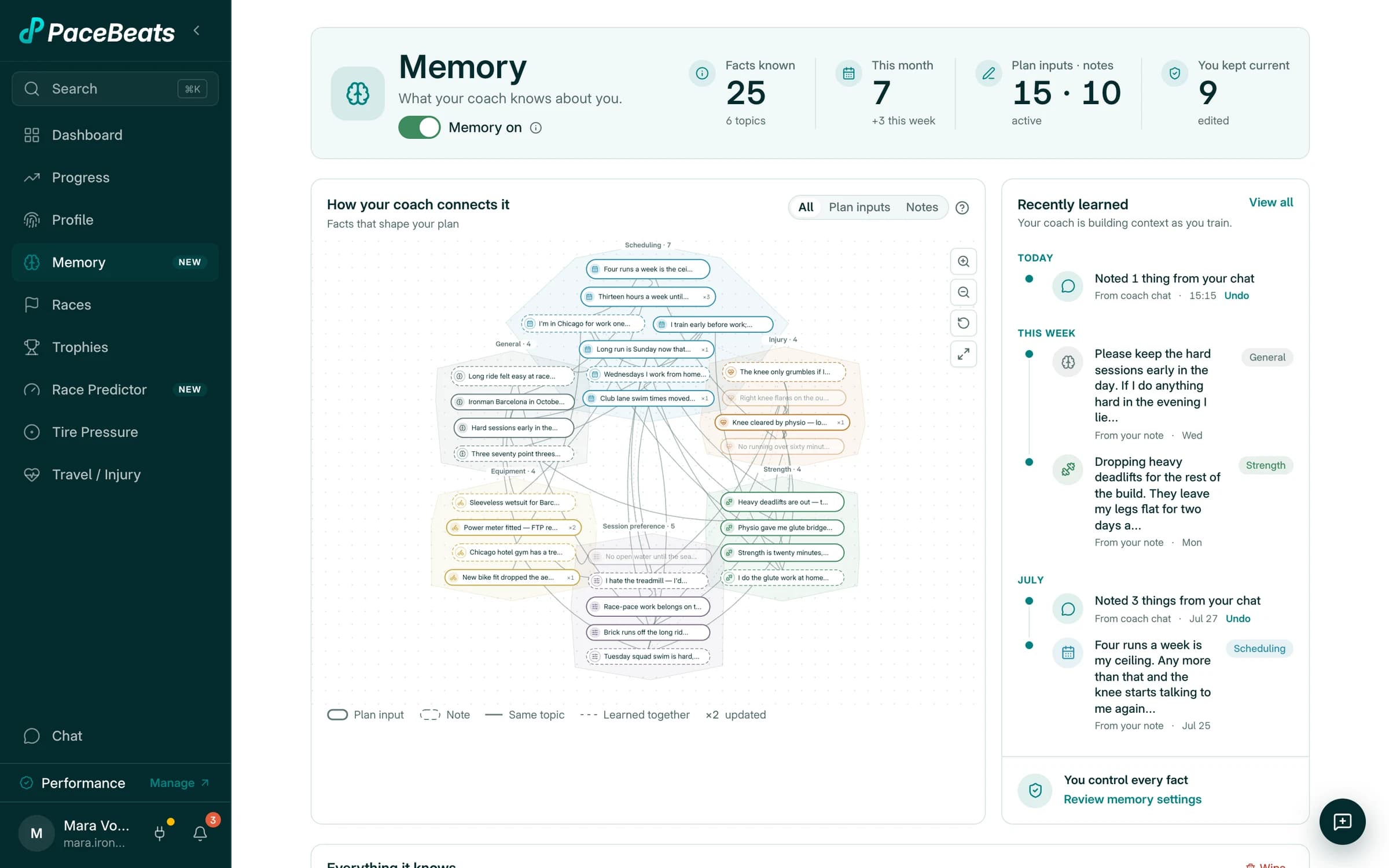
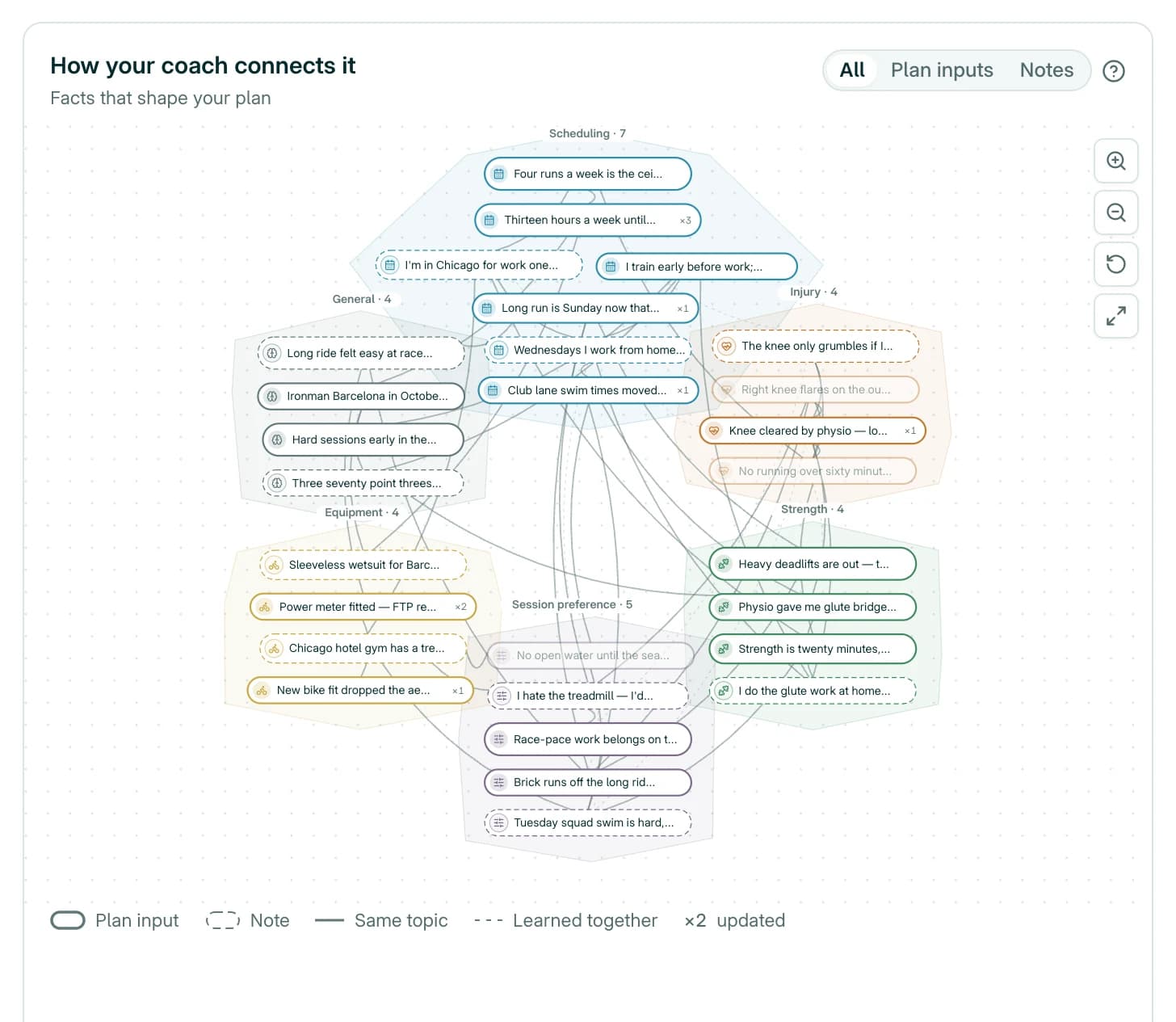
Facts, not transcripts
It keeps short facts — “long run is Sunday now”, “knee cleared by physio” — and connects the ones that belong together. It does not hoard your chats to go looking through them later.
Some facts shape the plan
A note stays a note until you promote it. Plan inputs change what gets built; notes are just context. You decide which is which, and you can move a fact back down again.
Old facts retire
When your availability changes, the old fact is superseded rather than stacked on top of. The page shows you what was updated and when, so there is one current answer instead of five contradictory ones.
Edit, undo, wipe
Every fact can be edited or deleted, every batch it learned can be undone from the timeline, and the whole memory can be wiped in one click.
What happens when Tuesday explodes?
Tell it, in your own words, and next week is built around what happened instead of the week you were supposed to have. Missed sessions do not get stacked onto the next two days. There is no guilt. A gap between plan and actual is data, not a character flaw.

Try asking
Swipe or use arrow keys to explore the full week
Say it in a sentence
“Travelling Thursday, keep the long ride.” PaceBeats maps that to a closed set of intents and applies it through rules. Anything it cannot honour is shown to you instead of quietly dropped.
Travel and injury aren't plan failures
Set a constraint mode in plain language by describing what's going on, what you can still do, and what training should aim for. The plan reorganizes every week around that mode until you turn it off.
Nothing is written until you accept it
The preview generates a week without writing it to your plan. Say “still too much” and PaceBeats previews a smaller version while keeping the days you already liked. When you activate it, PaceBeats persists exactly the week you approved.
While a mode is on, nothing grows
Shrink-only mode removes every action that would raise load. The “did that go as planned?” prompts go quiet because the plan already expects you to be off-pattern.
Can I actually do this week?
Most plans answer that in week six, when you’re already behind. PaceBeats answers it before the week is built. It checks the hours you have, the biggest session you’ve completed, and whether you can physically hold the intervals it wrote.
Next week · a week ahead
Next week’s plan needs about 45 minutes more than your calendar has. I’ll build the best week I can with your current hours — but if you can find that time, it fits.
Tap a day to add 15 min
Next week · Tuesday
To your watchThreshold intervals
1h15m · 62 load
Workout structure
| Step | Plan | Target |
|---|---|---|
| Warm-upeasy running | 15min | 5:55–6:25 /km |
| Threshold cruise3min easy jog between | 4 × 10min | 4:45–4:55 /km |
| Cool-downeasy running | 11min | 6:10–6:50 /km |
The verdict, a week ahead
Before a week is built, PaceBeats checks the ask against the hours your calendar actually gives you. If it doesn't fit, you get the verdict a week early and see whether the problem is your availability or the plan's arithmetic.
Intervals that hold up
Every interval is checked against how long a real athlete can hold that intensity: bike Z5 for 3–8 minutes, run I-pace under 5, swim CSS reps of 100–400 m. A 45-minute “threshold step” gets flagged before it reaches you.
No surprise four-hour ride
No single session goes more than about 10% beyond the biggest session of that type you've completed. Your history sets the ceiling, not an ideal template.
Ambition can't outrun adaptation
Weekly load can’t jump by more than your own derived ramp cap. Running ramps stay at 65% of that cap because impact injuries come from running. An independent brake compares your 7-day load with your 28-day load.
Did I actually do the workout?
You get a rep-by-rep readout of the workout you actually did. Every prescribed step is matched against what your watch recorded and gets its own verdict. It mirrors the session instead of grading you.
Threshold 4×10′· Monday
DoneInterval execution
| Step | Plan | Done | Target | Actual | Verdict |
|---|---|---|---|---|---|
| Warm-up | 15min | 15min | 120–160 W | 141 W | On target |
| Interval 1/4 | 10min | 10min | 250–270 W | 258 W | On target |
| Recovery 1/4 | 5min | 5min | -- | -- | Done |
| Interval 2/4 | 10min | 10min | 250–270 W | 264 W | On target |
| Recovery 2/4 | 5min | 5min | -- | -- | Done |
| Interval 3/4 | 10min | 10min | 250–270 W | 281 W | Above target |
| Recovery 3/4 | 5min | 5min | -- | -- | Done |
| Interval 4/4 | 10min | -- | 250–270 W | -- | Skipped |
| Recovery 4/4 | 5min | -- | -- | -- | Skipped |
| Cool-down | 10min | 6:15 | 100–140 W | 118 W | 63% |
Threshold 4×10′Done
It grades the workout your watch recorded
PaceBeats matches each prescribed step to the recording with the device's own step index, sequence alignment, or time slicing. The table still works when you skip the structured workout button.
The score checks the whole week
Your weekly execution score compares the time you spent in each zone with the intensity you planned. Redlining easy days or sandbagging intervals won't look like a well-executed week.
You're only asked about real deviations
A trimmed warm-up never triggers a question. Minor deviations stay out of the conversation. When something real happens, your explanation shapes future weeks.
Where is this all going?
To a date you picked. Enter your races and PaceBeats lays out every week from today to race day: base, build, peak, taper. It anchors the plan to your race dates instead of a template’s week one, so you see the whole plan before you commit to anything.
A, B and C races
You peak for the A, perform at the B, and use the C for pacing and logistics practice with no taper. Move or reprioritize a race and PaceBeats rebuilds the season, then tells you what changed.
Is there even enough time?
Every race gets a required build runway from its distance, its priority and your capacity. An under-prepared goal race is named up front, not discovered in week twelve.
A taper tuned for race day
PaceBeats carries your fitness, fatigue and form forward day by day through the taper, then tunes the taper to put you in the race-ready band on race day.
See the season before you pay
Preview the phased season build for free during onboarding. You see your actual plan as a chart and approve it before anything activates.
A finish-time range with the calculation behind it.
The race predictor uses your own thresholds and physiology to give you a range and per-leg splits. Its “what this projection considers” checklist names every layer it ran: course profile, the climate normal for your date, T1 and T2, running off the bike, and whether your bike plan is even pace-able. It also names the passes still waiting on data and what would unlock them.
What do I actually do on race day?
You get the sheet, not a pep talk. Upload your course file and PaceBeats writes the watts for each section of the bike, the pace for each phase of the run, and the fuel for every hour — all of it from your own thresholds, on one page you can print and carry.
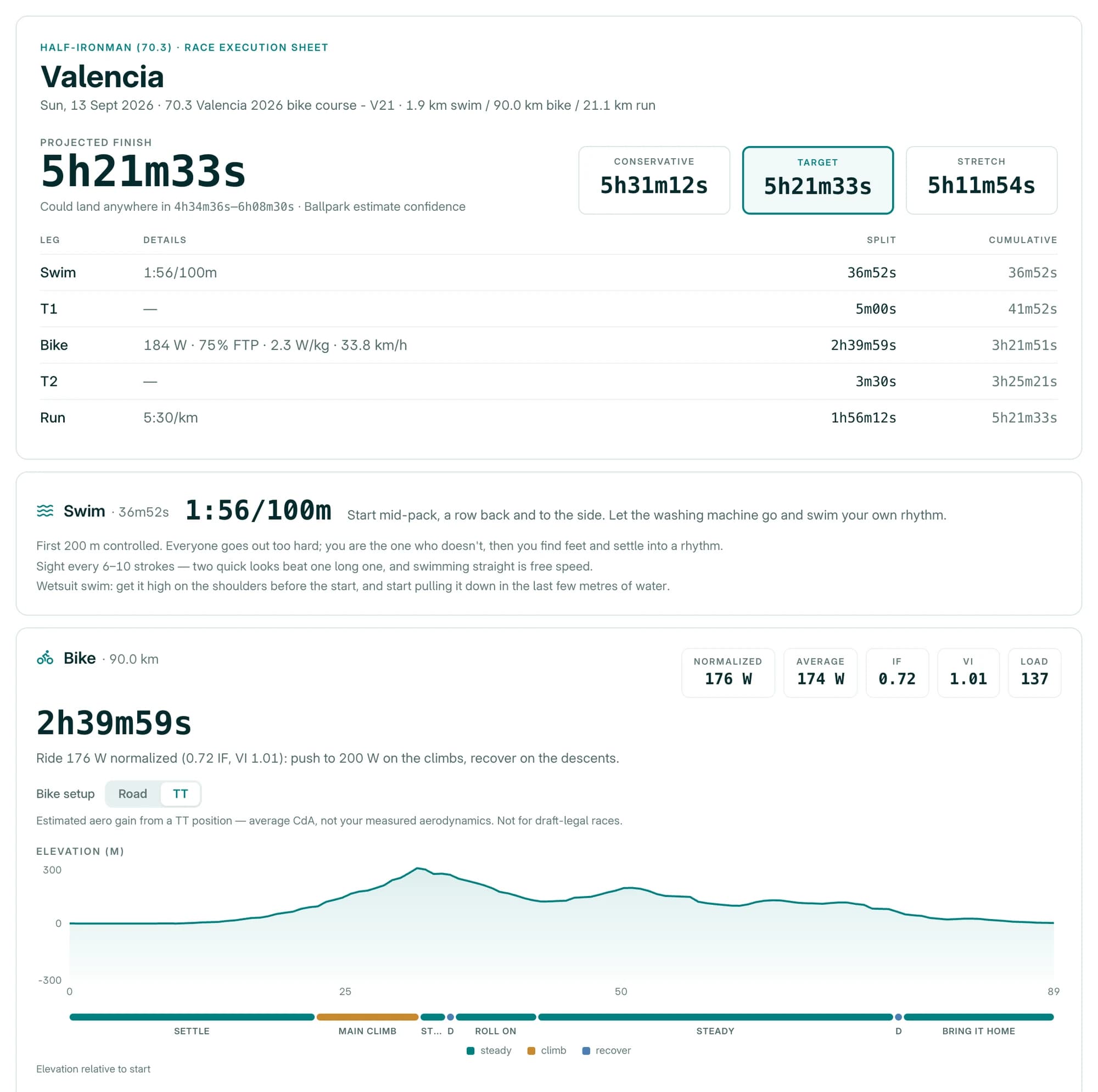
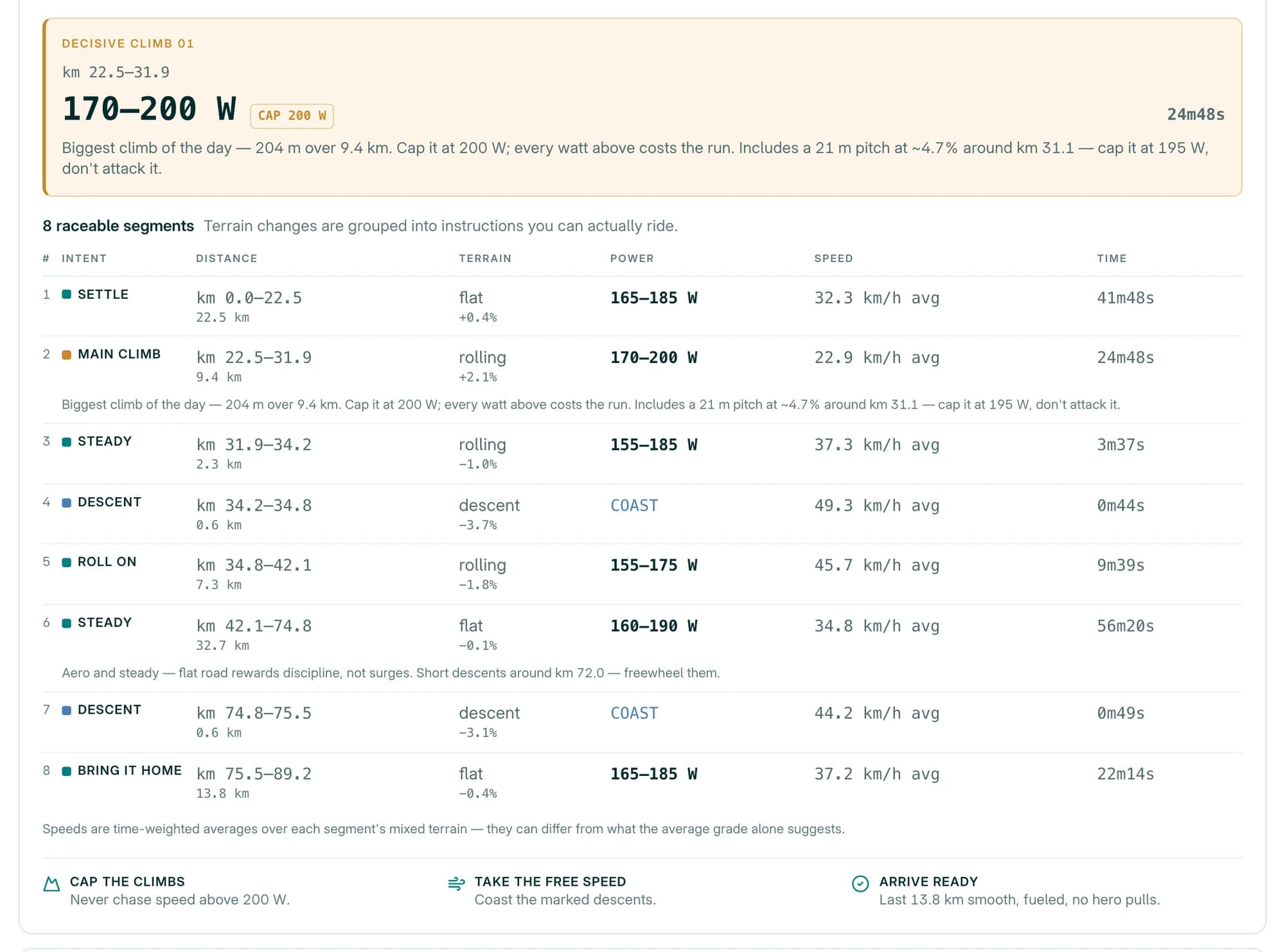
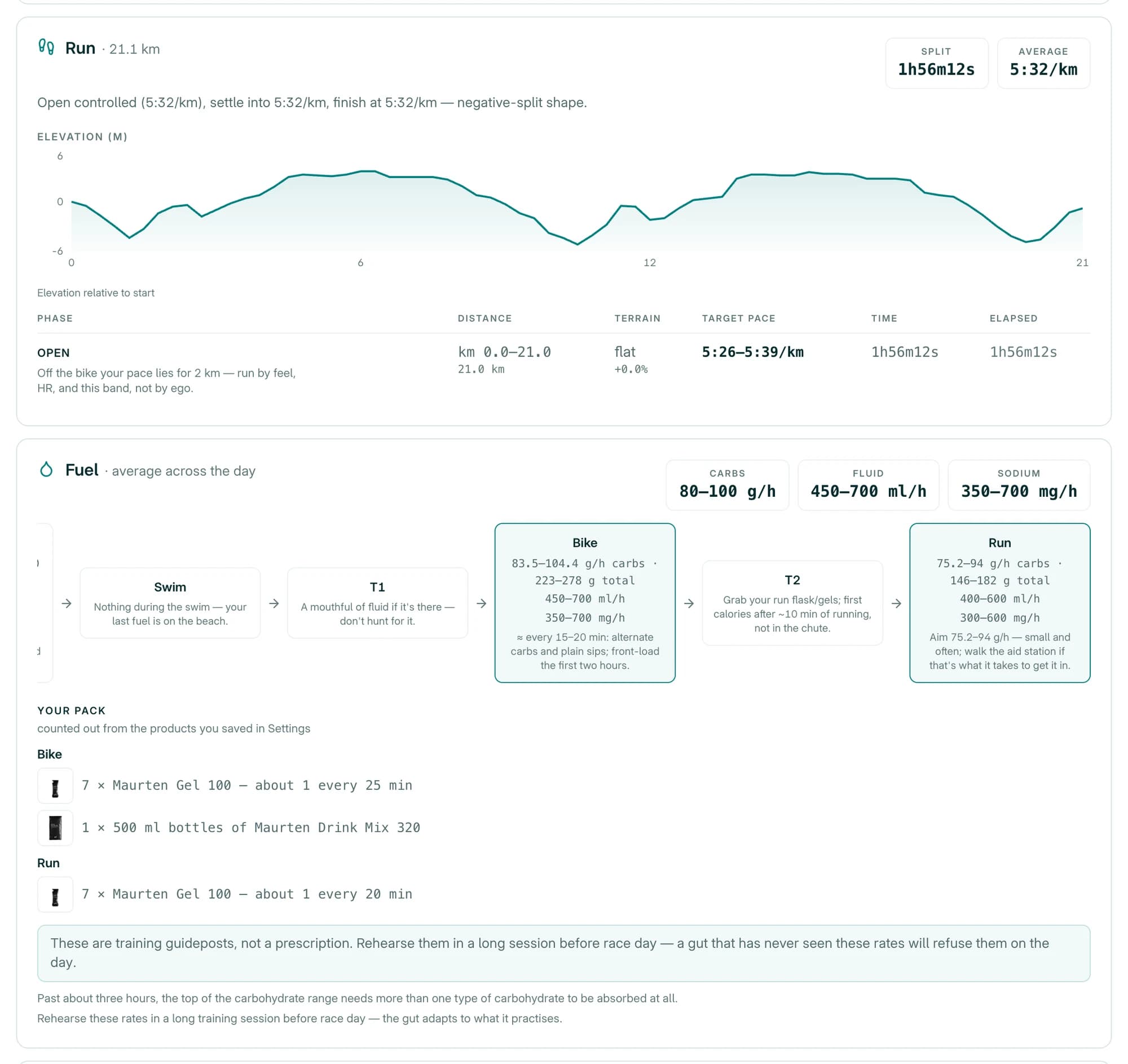
Watts for this course, not a course
Upload the GPX and PaceBeats cuts the bike leg into stretches you can actually ride to: settle, the main climb, roll on, bring it home. Each one gets its own power band, and the decisive climb gets a hard ceiling — every watt above it costs you the run.
A pace band, not a single number
The swim gets a target per 100 m and advice on where to line up for the start you'll actually have. The run gets its own band, split into phases wherever the run course gives it a reason to change.
Fuel counted in your own products
Tell PaceBeats what you actually carry — your gels, your drink mix — and the timeline counts them out leg by leg and hour by hour. Your pack comes out as “7 × Maurten Gel 100,” not as a number of grams.
One page, folded in a pocket
The whole sheet prints: projected splits, the power for each section, the pace bands and the fuel timeline. No phone, no app, no signal needed at kilometre sixty.
The Race Plan is part of the Performance plan. The prediction it is built on is included on every plan: your projected finish range, per-leg splits, confidence, and how the number has moved over the season.
Who said you could change my plan?
Nobody, until you do. Sometimes you ask — and sometimes PaceBeats speaks first: it reads the rides and runs you actually record, and when your own power says the threshold on file is out of date, it says so and then waits. Either way the change arrives as a card you approve, with the before and after in plain numbers. Keeping your current plan takes one click and costs you nothing.
Coach suggestion
Update your bike FTP
On your Saturday ride on Oct 24 you held 332 W for 20 minutes — your best 20-minute power in the last four months, and 11% above the 300 W on file. Bike FTP is roughly the highest power you could hold for about an hour flat out, and a hard 20-minute effort usually sits about 5% above it, which puts your real FTP nearer 315 W. You entered 300 W on Jul 6.
What changes
Set your bike FTP to 315 W (from 300 W)
Nothing changes unless you confirm.
Recent decisions
3 decisions, 1 waiting · Show all →
Today
Update your bike FTP
Keep Wednesday clear this week — I'm away for work.
Wednesday cleared: 2 sessions removed, load 500 → 423.
Thursday, October 22
Move your long ride to the day you actually ride
Monday, October 19
Ease your next run tempo
Why this week
Load held at your ramp capGuardrail
The season plan asked ~540 load this week. Held to 500 — the top of your own ramp band.
It proposes, then waits
A question PaceBeats raised on its own sits open until you answer it. Dismiss it and it does not happen — nothing is applied without an explicit yes. Say yes to a new threshold and it shapes the sessions built from that point on; the sessions already on your calendar keep the numbers they were given.
The preview cannot lie
The same engine function computes the before → after you see and runs when you confirm. After you confirm, the server re-derives and re-validates everything. It never trusts your browser's version of the story.
“Keep as planned” is first-class
Declining is one guilt-free click. Your plan stays as-is; we don't penalize or nag you, and we won't ask whether you're sure. Undos are always free.
Every decision is on the record
You get a full, paginated ledger of every proposal and what you did with it, plus a strip showing which decisions are actively shaping this week and whether each one was your choice or a guardrail we applied. A suggestion for a week that has since been rebuilt quietly expires instead of applying the wrong change.
The connection
Your devices. One training plan.
Connect Garmin for activities and recovery context, or Wahoo for your recorded rides and structured cycling workouts. Keep both if that is how you train. Each connection stays under your control.

Garmin Connect
optional · activities + recovery

Wahoo
optional · recorded activities
PaceBeats
unifies context, builds the week
Your Garmin watch
swim, bike + run workouts
Your Wahoo computer
structured cycling workouts
Strava
optional · finished sessions out
Garmin recovery signals shape next week’s plan — they won’t rewrite today’s workout on you.
Garmin, in
Connect through Garmin’s consent screen and choose the data categories to share. PaceBeats never sees your password. Finished sessions reach us within minutes, so you don’t have to press “Sync now.” We decode the FIT record stream for per-second pace, heart rate, and power. That also lets us recover your true pool-swim time instead of Garmin’s elapsed-only number.
Your watch, out
Your swim, bike, and run sessions upload as native Garmin workouts with the exact target bands shown in the app, scheduled for the right day. Tomorrow’s session is waiting when you wake up. Strength sessions go to your Garmin with sets, reps and rest.
Wahoo, there and back
Send structured cycling sessions to your ELEMNT, BOLT, or ROAM. Recorded activities return with the available power, heart-rate, and interval data. Confident matches with the same Garmin ride count once in your training history.
Explore the Wahoo connectionStrava and Withings, optional
PaceBeats can write the coached title and description to your Strava activity. Strava is outbound only, and PaceBeats sends only what you turn on. Withings weigh-ins provide weight and body-composition data.
Do I need a Garmin?
No. You can start by answering questions about your recent training and availability, then connect Garmin later. Garmin adds automatic activity sync and lets you send supported structured workouts to your device. Wahoo can also import your recorded activities and receive structured cycling workouts, independently or alongside Garmin. You can also upload supported activity files or log training manually. History-based insights depend on the data available.
Pricing
Two weeks of full coaching, free.
Finish setup and your first 14 days run on the full plan: the week rebuilt around your life, the coach that messages you first, and insights from your recorded training — fitness, fatigue, form, load, and race predictions, with recovery context when your connected device provides it. No card required. After that it is one plan with everything on: €249 a year, or €29 month to month.
Performance
€20.75/mo
Billed annually · €249/yr · save 28% · €29/mo month to month
One plan with everything on: training rebuilt around your life every week, a coach that knows you on WhatsApp, day-of coaching, and everything race day needs.
- A full adaptive plan for swim, bike, run, and strength, rebuilt every week
- Plan changes proposed for your approval — you always have the last word, with no monthly ceiling
- Your coach on WhatsApp — ask, reschedule, or report from anywhere
- A readiness check before your hard sessions, and heat-adjusted targets when it's hot
- Available insights from your recorded training — fitness metrics and weekly insights
- Unlimited goal races, a race predictor with per-leg splits, and the Race Plan with a printable race-day sheet
Finish setup and your first 14 days run on the full plan. No card required. Keep it and nothing changes.
Before you sign up
- Does PaceBeats work with Wahoo?
- Yes. Connect Wahoo in Settings to send structured cycling workouts to your ELEMNT bike computer and import available Wahoo recordings. Choose automatic delivery for today and the next six days, or send individual rides. Garmin can stay connected for other activities and recovery data.
- Do I need a Garmin?
- No. You can start by answering questions about your recent training and availability, then connect Garmin later. Garmin adds automatic activity sync and lets you send supported structured workouts to your device. Wahoo can also import your recorded activities and receive structured cycling workouts, independently or alongside Garmin. You can also upload supported activity files or log training manually. History-based insights depend on the data available.
- What do I get before I pay?
- Two weeks of everything. Finish setup and your account runs on the full plan for 14 days with no card: the plan rebuilt every week, the coach and its memory on WhatsApp, available insights from your recorded training, and race predictions with ranges, per-leg splits, and confidence when enough supporting data is available. When the two weeks are up you keep it for €29 a month or €249 a year. Nothing is charged automatically, and your training history stays yours whatever you decide.
- Can I see my plan before I pay?
- Yes, and before the free trial even starts. During onboarding you see your whole season as a chart with phases, load, hours, and race outlook, then approve it before anything activates. Finish setup and your first 14 days run on full Performance; no card is required.
- Will it change my plan without asking?
- No. Any change to your plan arrives as a proposal you must confirm, with the before-and-after numbers for each session it would move. Keeping your current plan takes one click and costs nothing. Every decision is recorded in a ledger you can read. If the week has been rebuilt since the proposal was created, the proposal expires instead of applying something wrong.
- What happens if I get injured, or have to travel?
- Set a constraint mode in plain language: explain what is going on, what you can still do, and whether training should aim for full recovery, holding fitness, or business as usual minus a sport. You see a preview before anything is written, and you can keep asking for less until it fits. While a mode is active, nothing can grow your week, and deviation prompts go quiet.
- Is this only for triathletes?
- No. Choose triathlon, run and bike, cycling, or running. PaceBeats builds the plan around that choice. A pure runner never sees a swim session, and a cyclist never sees a run they have to delete.
- Can I get my data back out?
- Yes. Export your profile, training, messages, preferences, and connections as JSON with one click. Disconnecting Garmin keeps your history by default; wiping it is a separate, explicit choice. Deleting your account first revokes consent at connected providers, including Garmin, Strava and Wahoo, then hard-deletes the account.
Ask about your week. Get a useful answer.
Set your race, connect Garmin or Wahoo when you're ready, and see your whole season, including its phases, load, and hours, before you commit to anything.
Build my plan