Runners
A coach-level plan for runners who train alone
Running-first is a first-class mode, not a triathlon hand-me-down: pick running as your focus and PaceBeats plans running — your races, your paces, your recovery. No swim slots to ignore. No bike sessions to delete.
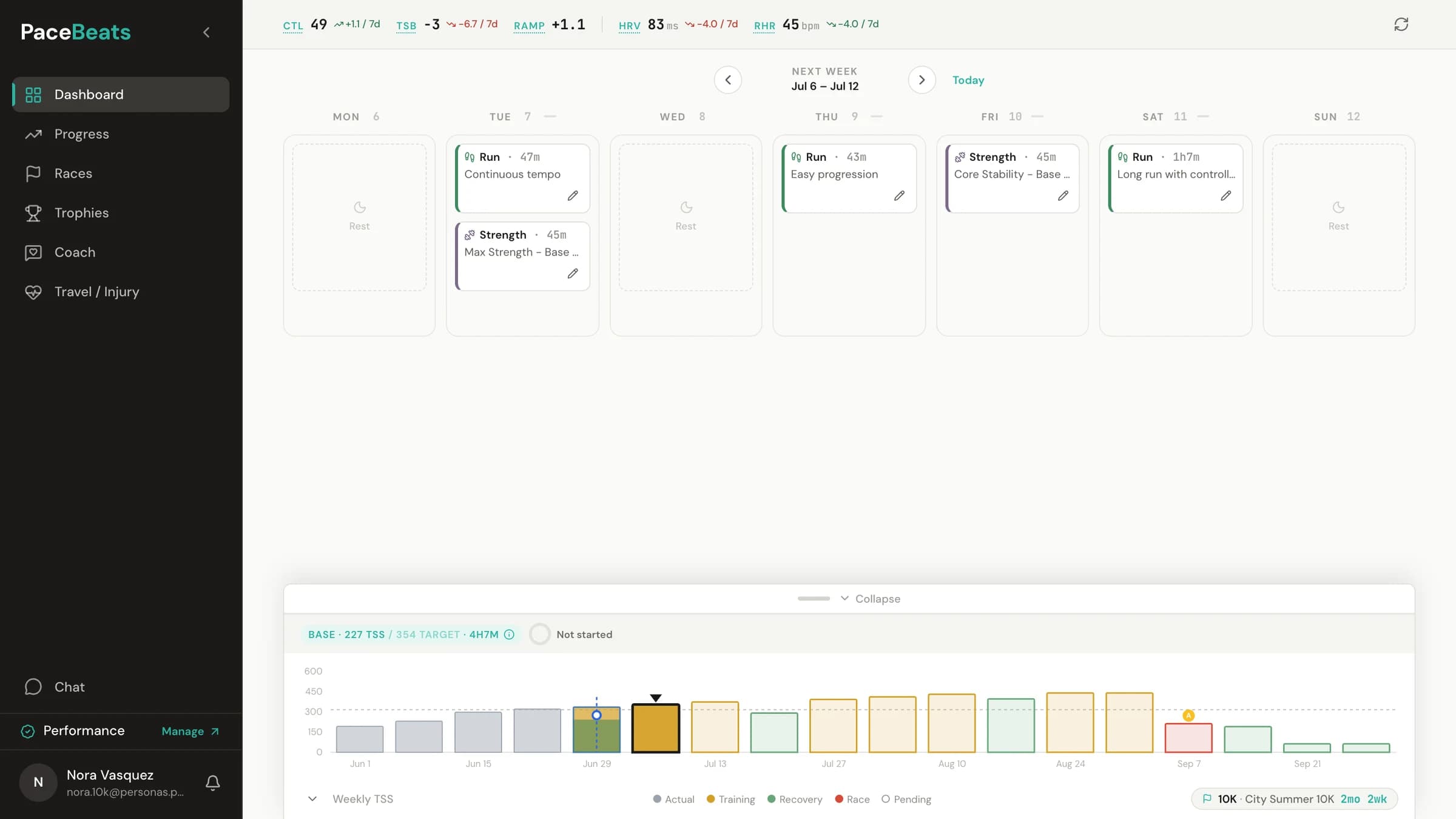
Real product, real athlete data — this is what your week looks like inside PaceBeats.
Runners get the worst of both worlds: static PDFs and triathlon hand-me-downs.
Train alone and you're the athlete and the coach: you set the paces, you decide when to push, you judge whether that ache is fatigue or trouble. Most runners outsource that to a static PDF that was out of date the day they downloaded it — or to a multi-sport app where running is an afterthought, with swim slots to ignore and run volume set by triathlon math. The weekly decision a coach gets paid for — what this week should be, given your race, your recovery, and your real life — is the part you're missing.
How PaceBeats helps
Running is a first-class mode
Pick running as your training focus and the PaceBeats engine plans running — and only running. Inactive sports are zeroed at the engine level, so there's nothing to ignore, hide, or delete from your calendar.
Built from a year of your running
PaceBeats reads up to a year of your Garmin history — mileage, paces, long-run patterns, threshold — so week one starts where you actually are, not where a template guesses. You see your full season plan before you commit.
Rebuilt every week around your real life
Flag travel, illness, or a brutal work week, and next week is rebuilt around your availability, your races, and your constraints. Tell it once — 'no early runs,' 'long run on Saturdays' — and athlete memory carries it into every week after.
Guardrails, not guesswork
Deterministic sports-science rules cap volume jumps, protect recovery days, and keep progression honest — the plan knows when to back off before your body forces it to.
Your watch is the interface
Every planned run lands on your Garmin with structure and pace targets, and your completed training syncs back nightly — no copying workouts off a PDF into your watch.
What you can expect
- A race-anchored running plan built from your actual mileage and paces
- A calendar with only running on it — nothing to ignore, nothing to delete
- Load progression with hard caps, so a good month doesn't become an injured one
- Planned runs on your watch, and completed runs back in the plan by morning
Questions athletes ask
Do I need a Garmin?
Yes — PaceBeats builds your profile from your Garmin data. It reads up to a year of your running history to set your starting volume and paces, and your planned runs sync back to your watch automatically.
Is this a triathlon app with the swim and bike turned off?
No. Running focus is a real mode in the engine: pick it and the other sports are zeroed at the source, so your volume, paces, long-run progression, and race runway are planned with running-only logic. There is nothing to delete.
How is this different from a static plan I can download?
A PDF can't see your week. PaceBeats builds your plan from your history, shows you the full season before you commit, and rebuilds it every week around your availability, your races, and your constraints — with deterministic guardrails on load the whole way.
What does it cost?
A human running coach runs €150–400 a month. With PaceBeats, every fitness metric is free forever, full coaching starts at €29/month, and every new account gets a 14-day full-coaching trial — no card required.
Next step