marathon training plan
A Marathon Training Plan That Rewrites Itself Every Week
Sixteen-week PDFs assume nothing goes wrong for sixteen weeks. PaceBeats builds your marathon plan from your Garmin history and rebuilds it every week around your long-run reality — with guardrails that know when to back off.
Best for
Marathon runners — first-timers to PR chasers — who want a plan that survives contact with real life.
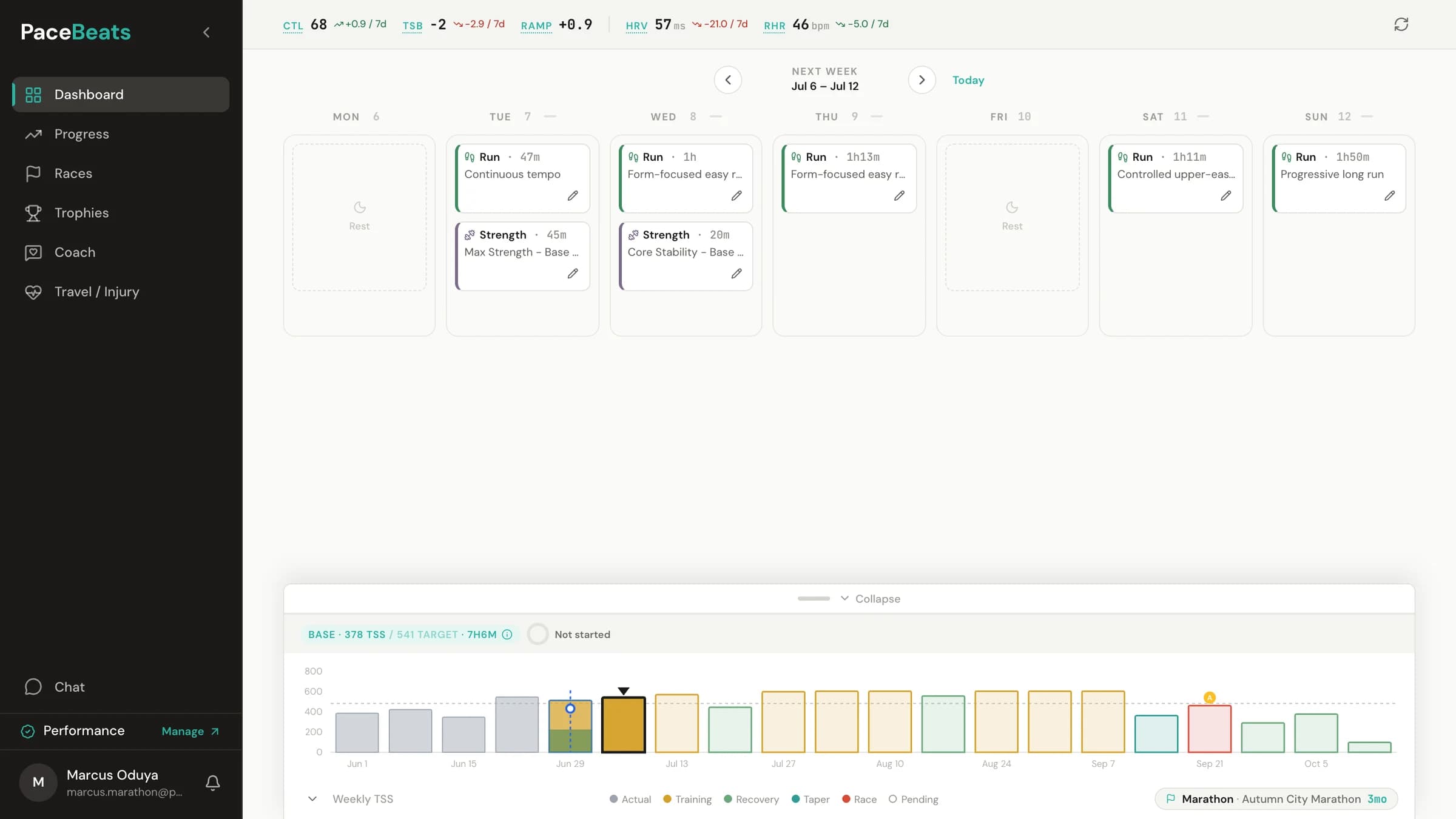
A real week from a PaceBeats athlete building toward this race — built from their Garmin history, rebuilt every week.
Why static marathon plans break by week six
A downloaded plan prescribes week twelve on day one, before it knows anything about how your build will actually go. Real marathon prep has travel, illness, brutal work weeks, and small niggles — and a PDF can't see any of them.
- They assume sixteen clean weeks — no travel, no illness, no wrecked stretch at work
- One missed long run turns into guilt math: skip it, cram it, or double up
- The paces were never yours — they came from a finish-time table, not your training history
- When your knee starts whispering, the PDF keeps prescribing the same mileage
Built from a year of your Garmin history
Before PaceBeats writes a single session, it studies up to a year of your Garmin data — your real paces, your real weekly hours, your real long-run history. Running is a first-class focus, not a triathlon hand-me-down: pick running and the plan is running, plus the strength work that supports it.
- Training paces come from what you actually run, not a goal-time lookup table
- Weekly volume starts from what you already handle and progresses from there
- Your long-run history sets an honest starting point for the marathon build
- You see the full season — base to taper — before you commit to anything
Guardrails and injury-safe progression
Deterministic sports-science rules decide your load: volume caps, recovery constraints, progressive overload. Most marathon injuries come from too much, too soon — so the plan is built to back off before your body forces it to.
- Weekly mileage and long-run length are capped per phase — no 30% jumps because a template said so
- Recovery weeks are scheduled on purpose, not left to guilt
- Quality sessions are dosed around the long run so hard days don't stack fatigue
- It never asks too much, too soon — progression is earned from your build, not assumed by a grid
The weekly rebuild
Every week, your plan is rebuilt around your race, your availability, and whatever real life throws at the schedule. Your race date doesn't move — the route to it does.
- Flag travel, illness, or a heavy work week — next week is rebuilt around it
- Completed runs flow in from your Garmin automatically, no manual logging
- Rate sessions in your own words — it's stored in your athlete memory and shapes how future workouts are written
- The marathon build stays intact: the plan reroutes around a bad week instead of pretending it didn't happen
Inside a real PaceBeats marathon week
Below is a representative peak-build week from a PaceBeats marathon plan — hours, TSS, and all. Yours won't look exactly like this, because yours is built from your data.
- The Sunday long run with its marathon-pace finish is the anchor session
- Two quality days maximum — every other session protects them
- Strength stays at a maintenance dose so it never steals from the long run
- Easy days are genuinely easy: that's what makes the hard days work
A representative marathon peak-build week
Peak-build, for a runner training ~7–8 hours a week. The Sunday long run with its marathon-pace finish is the whole point — every other session exists so you arrive at it ready to run it well.
Recover
- Rest or 30 min mobility + core
- Optional 30 min strength (maintenance)
Easy run + strides
- Run 60 min easy (Z2) + 6×20s strides
Marathon-pace quality
- Run 75 min — 3×12 min at marathon pace, 3 min float between
Easy run
- Run 50 min easy (Z2), conversational
Strength
- Strength 40 min — lower-body + core, maintenance load
Shakeout
- Run 45 min easy (Z1–Z2) + 4×20s strides
Long run
- Run 2:20 — Z2, last 30 min at marathon pace
- Rehearse race fuelling (60–90g carbs/hr)
PaceBeats builds weeks like this from your training history — then reshapes them when you miss a session, nail a hard one, or your schedule shifts. Predict your race time or start free.
Questions athletes ask
Do I need a Garmin?
Yes — PaceBeats builds your profile from your Garmin data. Up to a year of history sets your starting paces and volume, and your planned runs land back on your watch automatically.
How long should a marathon training plan be?
Most runners do well with 16 to 20 weeks. PaceBeats plans an 18-week marathon runway when your race date allows it, and works backwards from race day — base, build, peak, taper — rather than copying a fixed grid.
What happens when I miss a long run?
Nothing punitive. The plan never guilt-stacks a missed session into the next two days. Flag what happened — travel, illness, a wrecked week — and next week is rebuilt around your availability and your race, keeping the marathon build intact.
Next step